IAIFI Spring 2026 Wrap-Up
Opportunities Research Highlights News Join Research Papers Follow IAIFI Past Semesterly Newsletters
News from IAIFI Management
Thank you to everyone who attended our events this Spring and otherwise engaged with IAIFI on our research and activities at the intersection of AI and Physics! We have summarized some highlights and information from IAIFI for Spring 2026. Please feel free to reach out to us with questions or comments about any of the below. Best wishes for a safe and pleasant summer!
IAIFI Opportunities
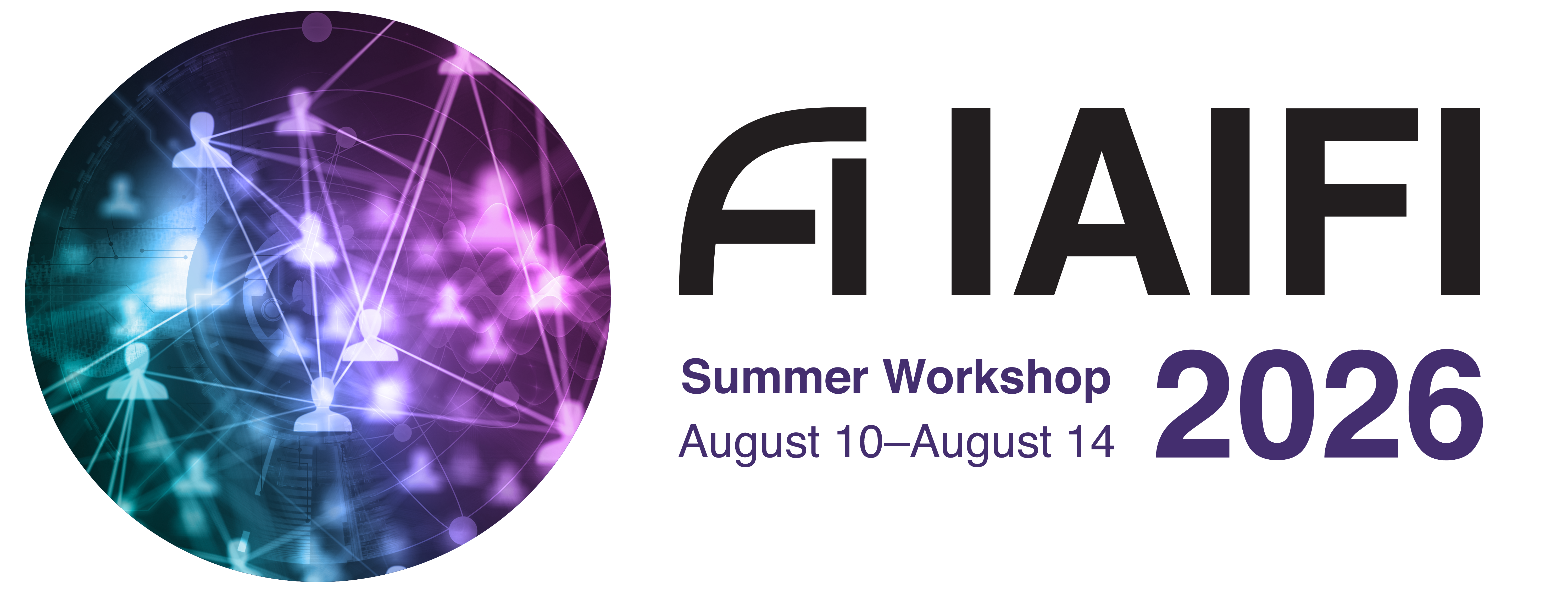
Summer Workshop in August
This August, we will hold our fifth annual Summer School (applications now closed) and Summer Workshop at MIT (https://iaifi.org/summer-workshop). The Summer Workshop will feature plenary talks, poster sessions, and networking events, including our first IAIFI Industry Day.
Summer Workshop Details:
- When: August 10 –August 14, 2026
- Where: Boston/Cambridge, MA (MIT)
- What: View the agenda on the Summer Workshop webpage. Lecturer details will be added as they are confirmed by the organizing committee.
- See FAQs on the Summer School webpage
MIT Summer Research Program (MSRP)
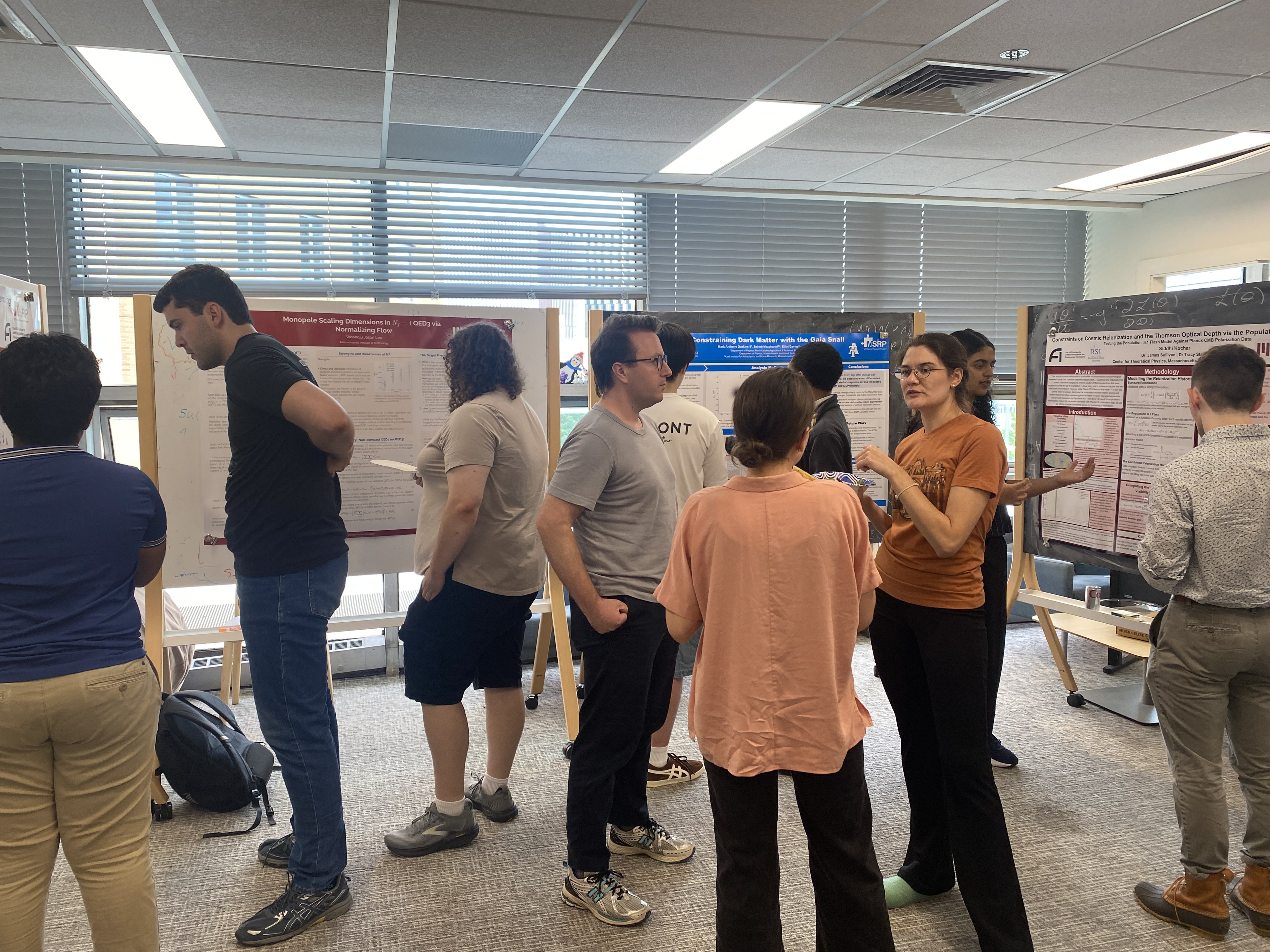
Applications now closed for the MIT Summer Research Program (MSRP); Undergraduate students (sophomore, junior, or non-graduating seniors) who might benefit from spending a summer on MIT’s campus, conducting research under the guidance of MIT faculty members, postdoctoral fellows, and advanced graduate students, are invited to apply annually to the MIT Summer Research Program (MSRP) and can indicate interest in working with IAIFI researchers.
IAIFI Colloquium Series
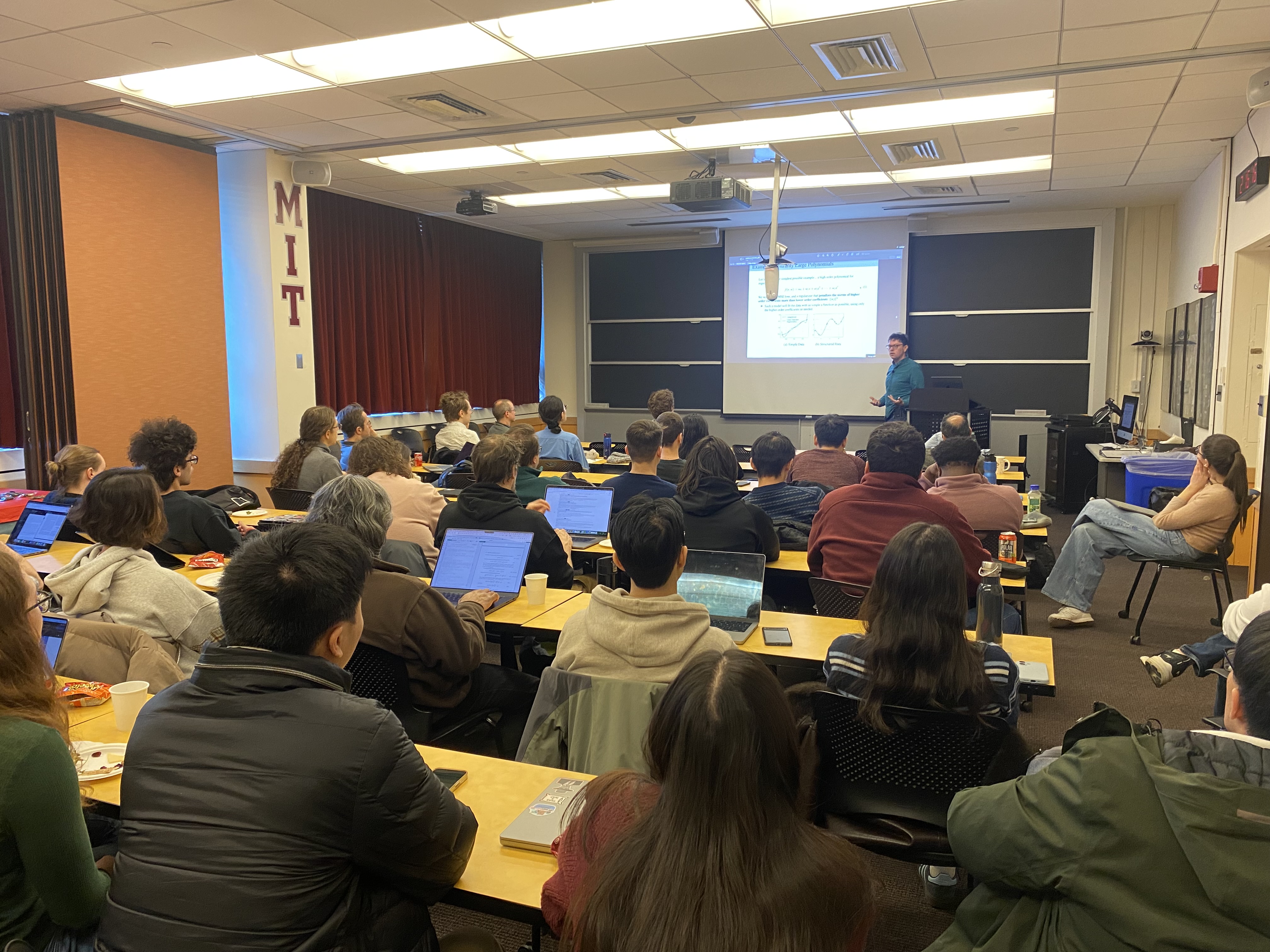
Thank you to our speakers for this term!
- February 13: Roger Melko (University of Waterloo)
- February 27: Andrew Gordon Wilson (NYU)
- March 13: Carlo V. Cannistraci (Tsinghua Laboratory of Brain and Intelligence (THBI))
- April 10: Tommaso Dorigo (INFN)
- April 24: James Requeima (Google DeepMind)
- May 8: Yury Polyanskiy (MIT)
If you missed any of this semester’s colloquia, you can watch recordings of all Spring 2026 colloquia on our YouTube channel, as well as recordings from previous semesters.
IAIFI Research Highlights
IAIFI regularly posts research highlights on our website, showcasing the innovative work of IAIFI investigators. View our Spring 2026 research highlights below!
- Quantum mechanics and neural networks
- Training a Foundation Model for Materials on a Budget
- L2M: Mutual Information Scaling Law for Long-Context Language Modeling
In Case You Missed It
Learn More about IAIFI Public Engagement Activities
IAIFI News
-
IAIFI Senior Investigator Tess Smidt contributed an essay to the Daedalus journal’s Winter/Spring 2026 issue on AI & Science. Check out her essay here, titled ‘Physics Is Different: Context, Culture & Craft in Effective AI for Physics.’ May 2026
-
A new white paper, co-authored by IAIFI Managing Director Marisa LaFleur, examines what it takes to coordinate large AI research teams such as IAIFI. Drawing on input from project managers across 25 AI Institutes, the paper offers recommendations for funders, universities, and research organizations. Read it here: ‘Project Managers Facilitate Interdisciplinary Collaboration in AI Research.’ April 6, 2026
-
Inspired by the white paper on the future of AI+Science (recently published in Machine Learning: Science and Technology), IAIFI Director Jesse Thaler shared his thoughts on this topic with MIT News. Read the MIT News article here. March 11, 2026
Join IAIFI
Visit IAIFI’s website for more ways to engage with the community.
Senior Researchers in the Boston Area
Senior Researchers include faculty members and senior research scientists with PI status. If you are interested in becoming an IAIFI Affiliate, complete the IAIFI Affiliate application form. Affiliate applications must include a Senior Investigator sponsor.
Details for Senior Researchers
Junior Researchers in the Boston Area
Junior Researchers include undergraduate students, graduate students, postdocs, and research scientists without PI status. If you are interested in getting more involved in IAIFI as a junior researcher, complete the Junior Researcher Interest Form.
Details for Junior Researchers
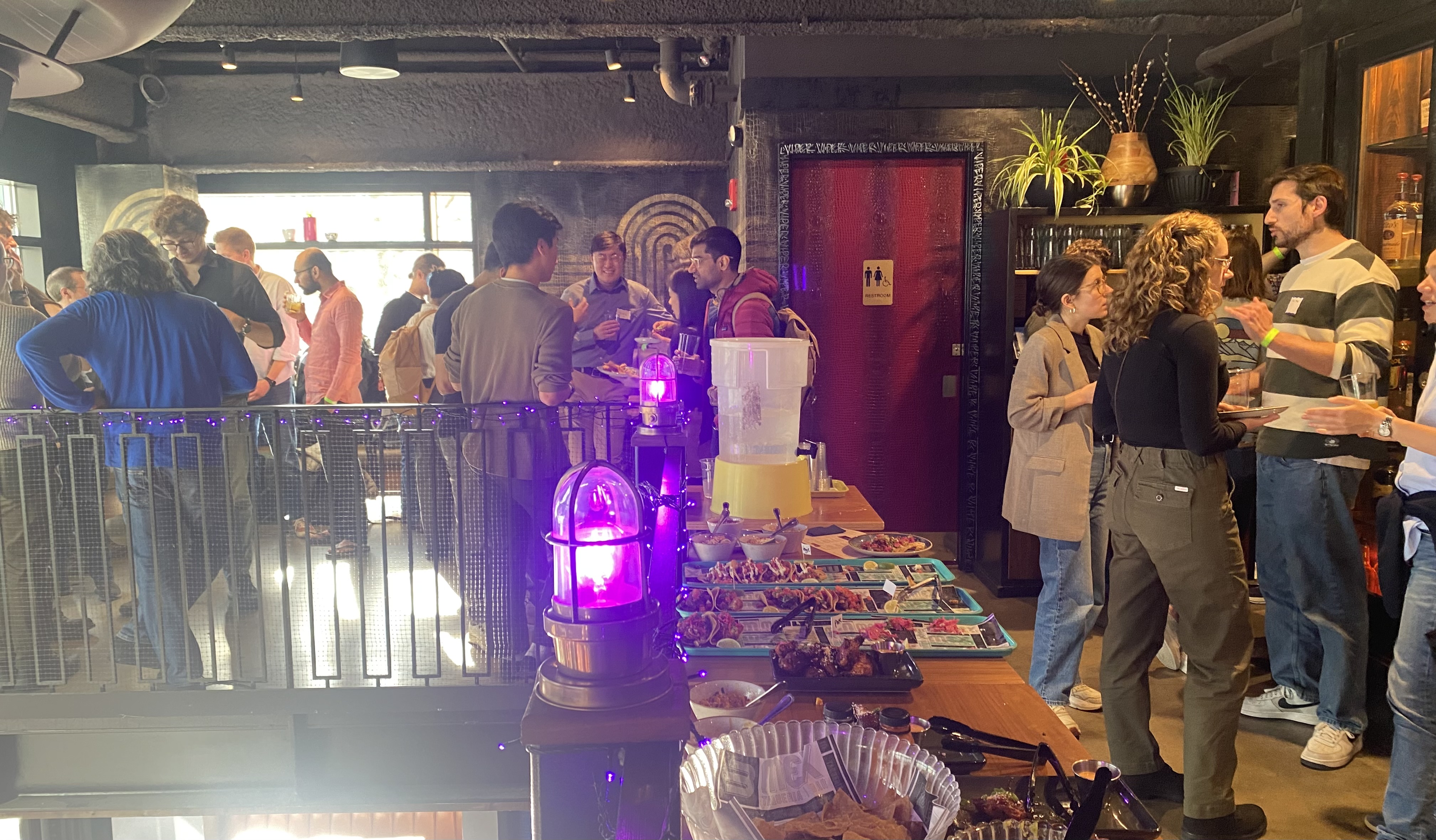
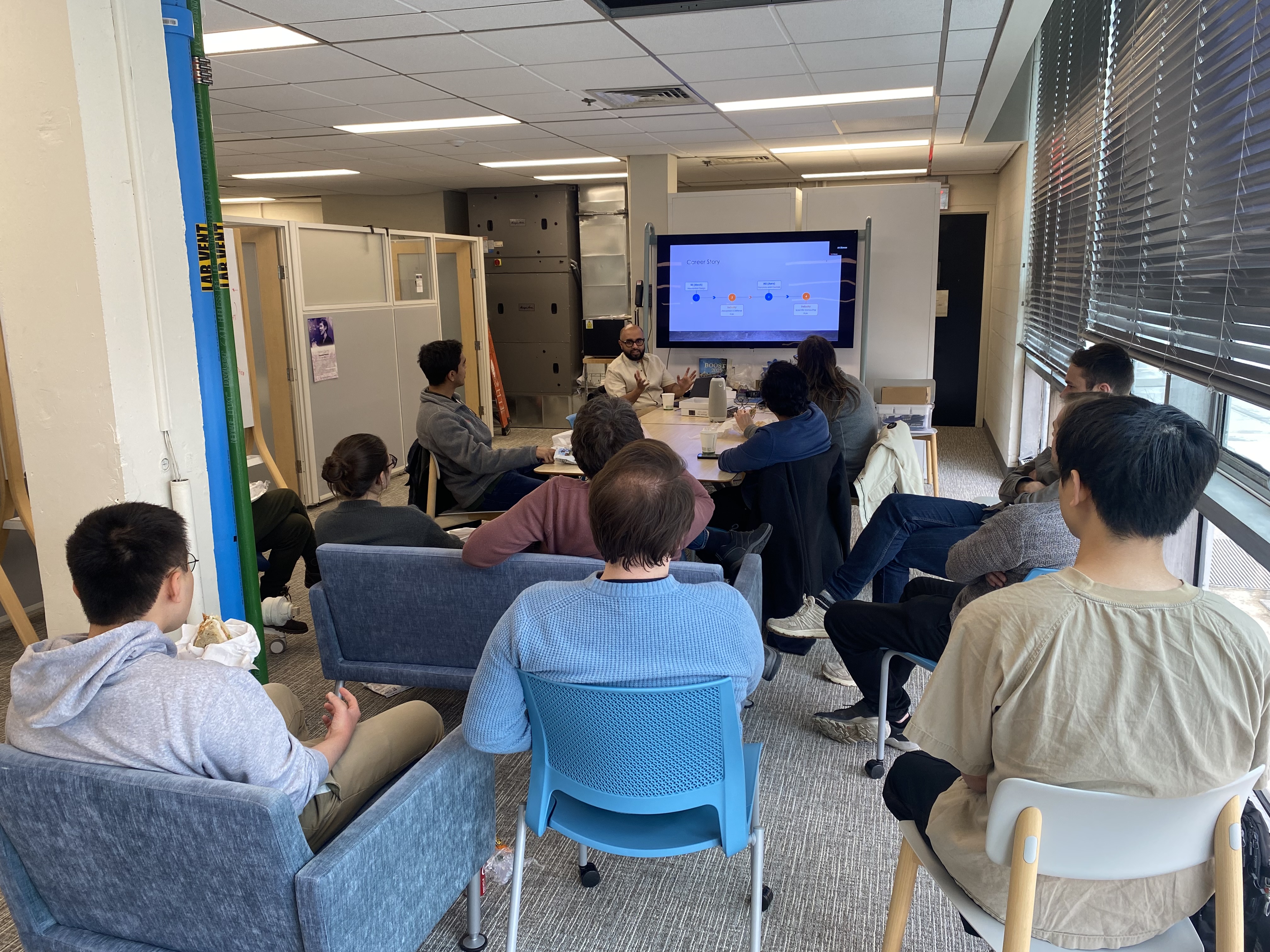
IAIFI members participate in a variety of events throughout the semester, including colloquia, industry lunch talks, and networking events.
IAIFI Research on arXiv
Read the latest IAIFI papers on arXiv! Here, the papers are grouped by the four IAIFI research domains.
Foundational AI
-
The Sample Complexity of Multiclass and Sparse Contextual Bandits
-
Everything at Every Scale: Scale-Invariant Diffusion with Continuous Super-Resolution
-
Toric Landau-Ginzburg models in threefold divisorial contractions
-
Self-Normalized Martingales and Uniform Regret Bounds for Linear Regression
-
Yau’s Affine-Normal Descent for Large-Scale Unrestricted Higher-Moment Portfolio Optimization
-
GenMatter: Perceiving Physical Objects with Generative Matter Models
-
Learning to Emulate Chaos: Adversarial Optimal Transport Regularization
-
MathNet: a Global Multimodal Benchmark for Mathematical Reasoning and Retrieval
-
Sven: Singular Value Descent as a Computationally Efficient Natural Gradient Method
-
Yau’s Affine Normal Descent: Algorithmic Framework and Convergence Analysis
-
End-to-End Efficient RL for Linear Bellman Complete MDPs with Deterministic Transitions
-
End-to-End Training for Unified Tokenization and Latent Denoising
-
Asymptotically Fast Clebsch-Gordan Tensor Products with Vector Spherical Harmonics
-
Machine learning of electronic structure and atomistic properties from the external potential
-
Does SGD Seek Flatness or Sharpness? An Exactly Solvable Model
-
High-accuracy sampling for diffusion models and log-concave distributions
-
Unsupervised Decomposition and Recombination with Discriminator-Driven Diffusion Models
-
Analytic Bijections for Smooth and Interpretable Normalizing Flows
-
PFT: Phonon Fine-tuning for Machine Learned Interatomic Potentials
-
Noisy dynamical systems evolve error correcting codes and modularity
View all Foundational AI papers
Theoretical Physics
-
Concatenating Algebraic Codes over High-Rate Quantum LDPC Codes
-
An Exponential Sample-Complexity Advantage for Coherent Quantum Inference
-
Forced Gap Post-Selection for Quantum LDPC Codes and their Operations
-
The classical Yangian symmetry of Auxiliary Field Sigma Models
-
Murmurations, Mestre–Nagao sums, and Convolutional Neural Networks for elliptic curves
-
Explicit or Implicit? Encoding Physics at the Precision Frontier
-
Variance reduction in lattice QCD observables via normalizing flows
View all Theoretical Physics papers
Experimental Physics
-
Many Wrongs Make a Right: Leveraging Biased Simulations Towards Unbiased Parameter Inference
-
Improving parton shower predictions via precision moments of energy flow polynomials
-
B-jet Tagging Using a Hybrid Edge Convolution and Transformer Architecture
-
AI Agents Can Already Autonomously Perform Experimental High Energy Physics
-
End-to-end Differentiable Calibration and Reconstruction for Optical Particle Detectors
-
Machine Learning on Heterogeneous, Edge, and Quantum Hardware for Particle Physics (ML-HEQUPP)
-
Building an AI-native Research Ecosystem for Experimental Particle Physics: A Community Vision
View all Experimental Physics papers
Astrophysics
-
Photometry is all you need: supernova classification as a mixing problem
-
Analytic compression of the effective field theory of the Lyman-alpha forest
-
High-dimensional inference for the γ-ray sky with differentiable programming
-
Robustness of Neural Networks for CMB Polarization Foreground Removal
-
UV and Optical Signatures of Late-time Disk Instabilities in Tidal Disruption Events
-
Dynamic Black-hole Emission Tomography with Physics-informed Neural Fields
-
Differentiable Stochastic Halo Occupation Distribution with Galaxy Intrinsic Alignments
-
Physics-Informed Neural Networks for Modeling Galactic Gravitational Potentials
-
Opportunities in AI/ML for the Rubin LSST Dark Energy Science Collaboration
-
MARVEL: A Multi Agent-based Research Validator and Enabler using Large Language Models
Contact and Follow IAIFI
Website Email X LinkedIn YouTube Mailing List